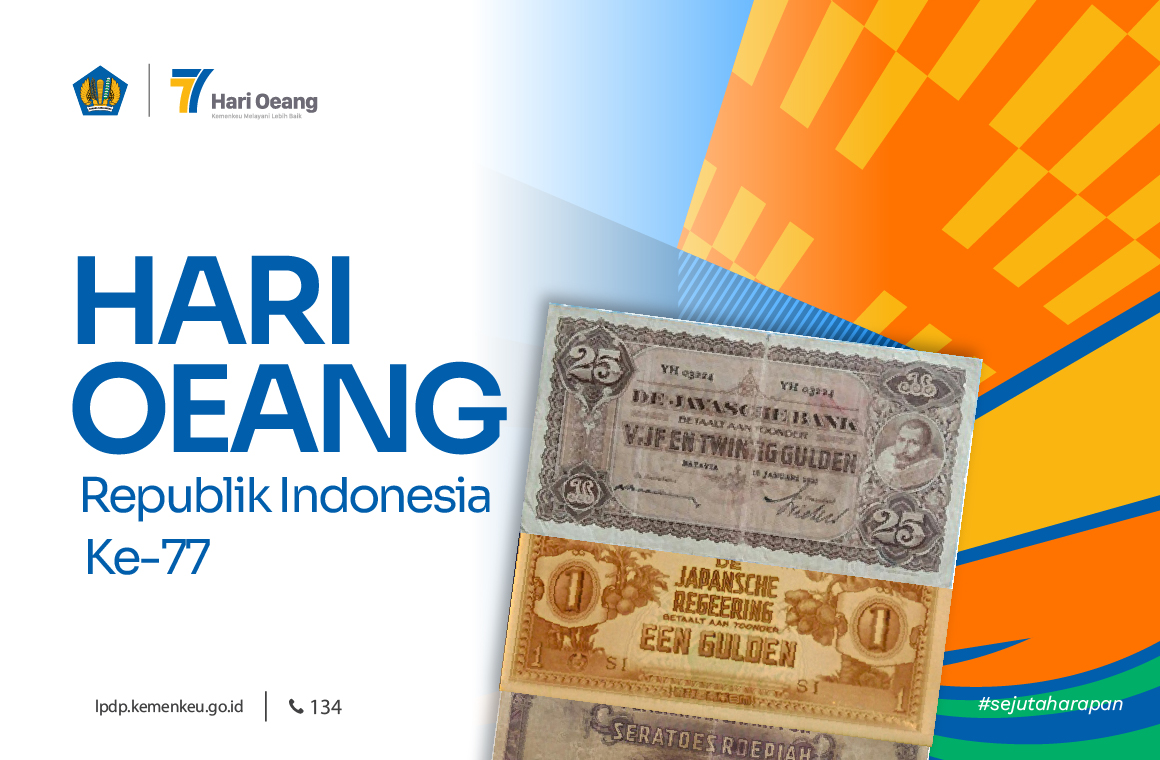
October 30 every year is commemorated as the Republic of Indonesia Currency Day (HORI). On that date, precisely in 1946, marked a historic moment when Indonesians could use the Indonesian Rupiah (ORI) as a valid means of payment.
The term "oeang" itself is an old spelling that is maintained based on agreements and holds significant historical value for Indonesia's early history. The establishment of ORI as a legitimate means of payment also signaled the nation's sovereignty as a new independent country.
"Starting tomorrow, the Indonesian Rupiah will circulate as the only valid means of payment... the currency itself is a symbol of the country's independence," stated Mohammad Hatta in an excerpt from his speech inaugurating the ORI via the Radio Republik Indonesia (RRI) broadcast on October 29, 1946.
The Ministry of Finance specifically and routinely celebrates HORI as a moment to emulate the Indonesian currency as a unifying force and a symbol of the nation's sovereignty. Apart from commemorative ceremonies, this annual celebration also hosts various activities within the Ministry of Finance.
More than just an annual celebration, the HORI momentum serves as a catalyst for LPDP to continuously support many young Indonesians in achieving their dreams through #UangKita.
A Brief History of HORI
Recalling the history of HORI is an effort to preserve the memory of Indonesia's struggle for independence. Hatta's famous speech during the ORI ratification did not arise spontaneously. The aspiration to have its own currency emerged early in the formulation of independence.
It all started with the Preparation Committee for Indonesian Independence (PPKI) arranging and ratifying the state's foundations. Then, the Proclamation of the Government of the Republic of Indonesia stated that Indonesia had four valid currencies on October 3, 1945.
The government planned to issue the Indonesian Rupiah (ORI). The second Minister of Finance, A.A. Maramis, formed the "Committee for the Printing of Indonesian Paper Money" on November 7, 1945, chaired by T.R.B. Sabaroedin from the Bank Rakyat Indonesia (BRI) headquarters and its members.
In the book "Kumpulan Buklet Hari Bersejarah II" by Ayatrohaedi, it is mentioned that Maramis instructed the G. Kolff & Co. Printing Workers' Union in Jakarta to find a place for printing ORI on October 24, 1945. Initially, ORI was supposed to be printed in Surabaya, but due to wartime situations in November 1945, the printing was done in Jakarta.
The printing of ORI could only commence in January 1946. It was done every day from 7 am to 10 pm. At that time, the first currency printed was the 100 Rupiah denomination.
Due to the precarious security situation caused by the Dutch Military Aggression, the production had to be relocated to areas such as Yogyakarta, Surakarta, Malang, and Ponorogo.
Finally, the circulation of ORI was authorized by the Vice President of Indonesia, Mohammad Hatta, as a legitimate means of payment.
Indonesia's Winding Road
Wars and inflation plunged Indonesia's economy into turmoil. The exact count of currency in circulation within the Republic of Indonesia was difficult. Added to this was the outcome of the Round Table Conference, which resulted in the formation of the United States of Indonesia (RIS) and the issuance of the RIS Rupiah on May 31, 1950.
When the RIS government ended and Indonesia returned, the circulation of RIS banknotes also ended on August 17, 1950. During Syafrudin Prawiranegara's tenure as Minister of Finance, the government implemented a program to reduce excessive currency in circulation. This program, known as the Sjafruddin Scissors, took place from 1951 to 1952.
During the specified period, the left portion of the currency could be exchanged for new currency issued by De Javasche Bank, in denominations of f2.50, f1, and f0.50. It was during this time that De Javasche Bank was nationalized and became Bank Indonesia (BI) on July 1, 1953.
After the establishment of Bank Indonesia in 1953, two types of Rupiah were valid means of payment in the Republic of Indonesia: those issued by the Government of the Republic of Indonesia through the Ministry of Finance for notes and coins below Rp5, and those issued by Bank Indonesia for notes above Rp5. As there was no functional difference observed, for standardization and efficiency, the issuance of currency was carried out solely by Bank Indonesia.
The Ministry of Finance plays a significant role in maintaining economic stability and managing the national finances. The Rupiah in circulation today bears the signatures of both the government and Bank Indonesia, based on Law Number 7 of 2011 regarding Currency. The Minister of Finance's signature is included alongside the Governor of Bank Indonesia in various new currency denominations since the 2016 emission.
That concludes the brief history of the Indonesian Oeang Day. The history of Indonesian Money Day reflects the nation's long journey in managing a stable and powerful financial system.