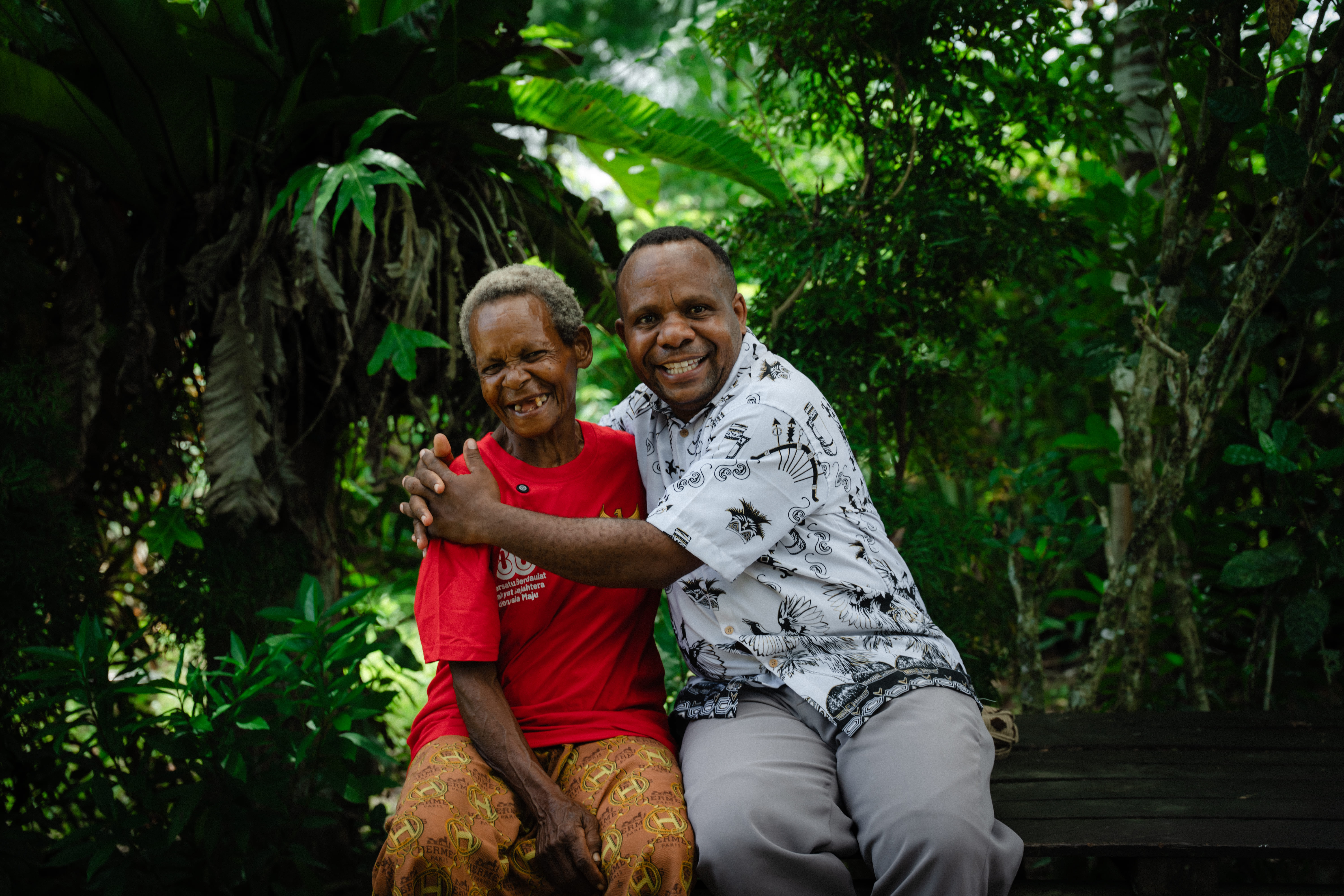
Papua is often called paradise on the eastern horizon of Indonesia. Its majestic rainforests are recognized as one of the world’s centers of megabiodiversity. Dense jungles, mist-covered valleys, steep cliffs, and towering mountains shape a landscape that feels both grand and almost primordial.
Yet this natural splendor also brings formidable geographical challenges. Equal access to basic services remains a persistent structural issue. Many schools operate with severe limitations—shortages of teachers, minimal infrastructure, and low accessibility, particularly in remote areas that require hours of overland travel or can only be reached by air.
In such conditions, thousands of children face the threat of dropping out due to distance, security concerns, and family economic pressures.
In Kampung Putaapa, Mapia Tengah District, Dogiyai Regency, Central Papua Province, the local school once only provided classes up to the fourth grade. To continue their education, children had no choice but to travel to a neighboring village called Modio—26 kilometers away.
Felix Degei, born in Putaapa in 1988, was one of those children. His only means of transportation was his own physical endurance. Together with other students, he walked through forests and crossed rivers every single day.
“We would leave at dawn, walking to school. After classes ended, we walked back home again. We did that for two years,” Felix recalls of the 26-kilometer journey that remains etched in his memory.
Degei is a member of the Mee tribe, one of the largest Indigenous groups in Papua, concentrated in Dogiyai, Deiyai, and Paniai. He is the third of six siblings; two of his older siblings have passed away. His father, a retired Catholic religion teacher at SD Negeri Inpres 1 Bumi Mulia Wanggar in Nabire, instilled discipline and the courage to dream. His mother, a homemaker, nurtured the family’s spirit with unwavering love and support.
To this day, Putaapa is still not fully connected to electricity and internet services. Many children continue to face the risk of leaving school due to distance, safety issues, and economic hardship.
Felix vividly remembers sitting with his father’s Tiens radio, listening to distant broadcasts from Melbourne. Every time the announcer said, “Radio Australia from Melbourne,” he quietly stored those words in his heart. One day, he told himself, he would get there.
That was where the dream began.
A Dream Born from a Radio and a Priest
As a junior high school student, Felix’s worldview was still limited. At that time, he believed the most prestigious higher education institution was simply a local college in Nabire. Jayapura felt distant, let alone studying abroad.
Two seemingly small moments changed his perspective.
The first was hearing “Radio Australia from Melbourne” broadcast through his father’s radio. Each mention of Melbourne felt like a personal calling.
Friends reacted with disbelief, even mild ridicule. Reaching the district capital was already difficult—how could someone from their village possibly dream of going to Australia?
Felix was not discouraged. He understood their reaction reflected reality. But he also remembered his father’s advice:
“If you want to see people with different skin colors, different hair, if you want to try different food, experience a different climate and weather, then you must study—go to school.”
After graduating from elementary school, Felix continued to SMP YPPK Santo Fransiskus Assisi in Moanemani, now the capital of Dogiyai Regency. He later moved to Nabire to attend SMA YPPK Adhi Luhur. Each step—from remote village to regency center to regional capital—gradually broadened his horizons.
In his eleventh year of high school, a Jesuit priest read aloud the biography of a Mee priest who had completed his doctoral studies in Rome. Felix was stunned. If someone from the same tribe, the same land, the same upbringing could reach the Vatican, then perhaps those boundaries were only imagined.
“At that moment, I became optimistic. If someone from my own tribe could do that, then surely I could too. That was my milestone—the jumping stone.”
From then on, his dream extended beyond Nabire or Jayapura. He wanted to go further.
From Rejection at AAS to Acceptance at LPDP
Felix completed his undergraduate degree in Guidance and Counseling at Universitas Cenderawasih in 2012 and later worked as a teaching assistant. In 2013, he attended an English course at the Indonesia Australia Language Foundation (IALF) in Denpasar, Bali. There, he learned about international scholarships such as Australia Awards, Fulbright, Chevening—and LPDP.
He applied for Australia Awards but was unsuccessful. He participated in English Language Training Assistance (ELTA) funded by the Australian Embassy. He tried again. He waited. The announcement never came.
Amid that uncertainty, he applied for LPDP.
“Since then, although my heart was set on Australia Awards Scholarship (AAS), I realized LPDP was also a great opportunity,” he said with a smile.
In 2016, good news arrived sooner than expected. Felix was accepted as an LPDP awardee under the Affirmation scheme for disadvantaged regions.
“Praise God, God opened the way, and in 2016 I became one of the LPDP recipients,” he recalled.
The term “affirmation” acknowledges that not everyone begins from the same starting line. Structural barriers like those faced by Felix and many Papuans require proactive policy intervention. One key advantage of the Affirmation scheme was the removal of the English certificate requirement at the application stage. Instead, awardees were fully funded to undertake intensive language preparation, known as Pengayaan Bahasa (PB).
Felix joined the program at Universitas Negeri Malang. Tuition, accommodation, and living expenses were fully covered to ensure participants could achieve the required IELTS score.
Australia was no longer a distant voice from the radio.
In January 2017, Felix departed for Australia to pursue a Master of Education at the University of Adelaide.
Before leaving, he reached out to his network and connected with a teacher from Merauke studying at Flinders University.
“We both come from remote Papua. I have plans to continue my study—could you help me settle in first?” he asked via social media.
The teacher picked him up at the airport and hosted him for two weeks while he searched for housing. Felix eventually found a shared house near campus, living with eight others—the only Indonesian among them.
“If I wanted to survive and communicate, I had to use English.”
He forced himself to ask questions in class, visited the writing center, and maximized campus facilities.
“Thank God I didn’t experience extreme culture shock, because I came to study. If I didn’t know something, I asked.”
The multicultural environment accelerated his growth and strengthened his resilience.

Felix also shared that he was able to set aside part of his scholarship allowance to support his two younger siblings’ undergraduate studies. One studied at Akademi Pembangunan Masyarakat Desa (APMD) in Yogyakarta, focusing on rural community development. Another pursued Social and Political Sciences at Universitas Cenderawasih.
“Once again, I must thank LPDP. Because I received this scholarship, we could also share it with my younger siblings—and they have now graduated.”
Turning Down Other Career Offers, Choosing the Calling to Teach
After completing his studies, many opportunities were open to him. He could have returned as a permanent lecturer at Universitas Cenderawasih. He was invited to assist a member of the Regional Representative Council (DPD RI) in Jakarta.
Rationally, these career paths were promising.
But Felix thought about Putaapa. He thought about schools without teachers. He thought about high school students who still struggled to read and multiply. He remembered being mocked for his Indonesian language skills when he first attended high school.
“If I disappear, that would not be good,” he said softly.
He chose to return to Nabire—not to the capital, not to the center of power—but to his own community.
Since 2019, Felix has worked tirelessly. In the mornings, he teaches at SMA Negeri 1 Plus KPG (Kolese Pendidikan Guru) Nabire as a contract teacher. In the afternoons, he lectures at the PGSD program unit of Universitas Cenderawasih in Nabire. He also teaches at Universitas Satya Wiyata Mandala (USWIM) and tutors English at a Catholic seminary preparatory school.
Most of his high school students come from remote coastal and mountainous areas. Many still struggle with basic literacy and numeracy.
“For multiplication from one to ten, we sometimes have to wait minutes for them to recite it fluently. Speaking properly is still far below what should be expected at the high school level.”
Some non-Papuan teachers assigned there are often shocked, wondering if they have entered the wrong classroom.
For Felix, this is precisely why he must be present—as a role model and as an Indigenous Papuan educator.
“This is a problem that requires all stakeholders to take part in improving literacy and numeracy. And I always remember my own journey to this point.”
Felix’s story reflects the strategic importance of LPDP’s Affirmation scholarship scheme for Papua. It is not merely educational funding, but a structural intervention to expand access for regions facing geographic and economic limitations.
Affirmation means the state is present for those who have long been distant from information and opportunity.
Felix is the embodiment of that policy design. Investment in one individual becomes an investment in an entire community. Every student he teaches, every future teacher he mentors, extends the impact of a well-targeted policy.
All for the future of Papua.