Railways are among the oldest mass transportation modes in Indonesia. With considerable carrying capacity, interconnecting cities and provinces, and dedicated tracks, trains have become a favorite ground transportation mode.
The first railway line opened during the Dutch colonial era, linking Semarang - Vorstenlanden (Solo - Yogyakarta) in 1867. Speed has been a primary attraction since the introduction of trains in the archipelago.
In Pramoedya Ananta Toer's novel "Bumi Manusia," the character Minke expressed admiration for the train transportation technology at the end of the 19th century. The ability to travel from Jakarta to Surabaya in just a day was remarkable, as it previously took up to three days using other transportation modes. Now, over 100 years later, the Jakarta-Surabaya route is set to take less than 4 hours.
The railway system has evolved from colonial times to independence and remains a vital part of modern transportation. Fast trains have become a hallmark of development in advanced countries. Indonesia, too, is not lagging behind in introducing high-speed train technology. The extensive project called the "Merah Putih High-Speed Train" is in progress, one of its routes connecting Jakarta to Surabaya.
Despite the existing diesel trains, which have improved their speed over time from 13 hours to 8.5 hours between these major cities, the Merah Putih High-Speed Train aims for a shorter travel time, reducing the Jakarta-Surabaya journey to 3 hours and 40 minutes.
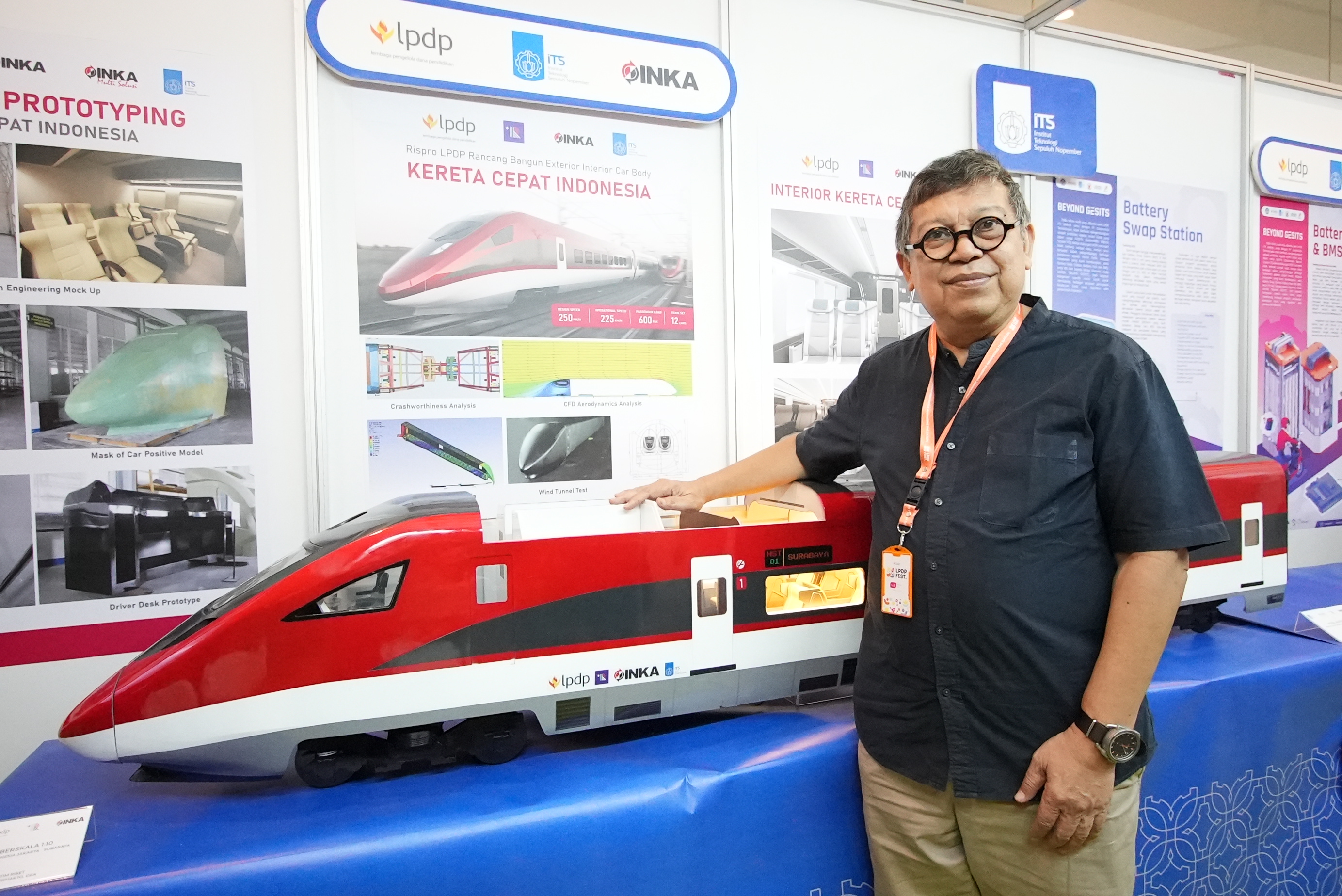
Dr. Agus Windharto, DEA, the head researcher funded by the Education Fund Management Institution (LPDP) through the Innovative Productive Research (RISPRO) Competition, focuses on designing the exterior and interior of the Indonesian High-Speed Train. The three-year-funded research involves a team from the Department of Industrial Product Design at the Sepuluh November Institute of Technology (ITS).
"In our team, I, as the lead researcher, am responsible for designing the exterior and interior carbody of the Indonesian High-Speed Train. Our scope of work covers the carbody from front to back, both externally and internally," stated Agus Windharto during the LPDP Fest 2023 research exhibition.
From a technological perspective, Windharto's carbody design significantly supports the train's speed. With his design, the Merah Putih High-Speed Train can reach a maximum speed of 250 km/h, operating at 200 to 220 km/h. This design is a reason Jakarta-Surabaya can be traveled in less than five hours.
There's a significant difference in carriage weight. While a conventional train's carriage with 50 executive class passengers weighs 50 to 60 tons, Windharto's designed high-speed train weighs only 40 to 45 tons due to its Extruded Aluminium Alloy 6061 base.
Despite using aluminum instead of stainless steel and being lighter, it doesn't compromise quality or safety. Everything has been meticulously designed and calculated based on four essential aspects: reliability, availability, maintainability, and safety (RAMS).
The ITS Industrial Product Design research scope for the high-speed train includes cabin envelope and cockpit design, human factors engineering and ergonomics studies, aerodynamic testing, and carbody structure design and testing. Besides creating the exterior and interior prototype of the high-speed train, this research involves CFD and FEA engineering analysis data, Intellectual Property Rights (IPR), and 3D train animations.
Windharto is confident that his design won't fall short compared to high-speed trains in developed countries like Japan, France, and Germany. Educated at the Université de Technologie de Compiègne (UTC) in France, specializing in aircraft design and having experience with Airbus, his interest in railway transportation started during France's development of the TGV (Train à Grande Vitesse) high-speed train.
By leveraging his research background and benchmarking against global high-speed train development centers, he believes in presenting the best work by an Indonesian.
Realizing the High-Speed Train Made by Indonesians
For Windharto, the high-speed train project represents the pinnacle of railway technology. It signifies progress in the railway industry, especially in developing high-speed train technology.
"So, with this high-speed train, there will be an acceleration in mastering technology. Universities, researchers, BRIN (National Research and Innovation Agency) as research partners, research and testing institutions, and PT INKA as manufacturers are involved," explained the Industrial Product Design lecturer at the ITS Department of Industrial Product Design.
The arrival of the high-speed train era is expected to boost domestic component production research, reducing imports. Windharto sees this as an opportunity for the next generation to conduct research on high-speed train components. It holds promise in meeting public transportation needs if Indonesia aspires to become a developed country.
"This strategic research opportunity needs to be continuously developed for the younger generation. From undergraduate to doctoral students and millennials, they should not only be interested in digital startups but also in manufacturing technology and transportation technology because it's highly needed in our archipelagic country," hoped Windharto.
The Merah Putih High-Speed Train project is a prestigious and colossal undertaking, involving multiple parties. Collaborative research, including machine, electrical, material, and more, is conducted with several Indonesian universities.
The design and prototyping research for the Merah Putih High-Speed Train has gone through digital analysis and testing phases, ready to move on to physical production. The production cost for two high-speed train car bodies is estimated at no less than Rp 80 billion. The high-speed train's production process is handled by PT INKA (Indonesian Rolling Stock Manufacturer) headquartered in Madiun, East Java. The high-speed train is expected to be completed by 2025, with system testing scheduled for 2026.