Every motorized vehicle rolling on the roads is equipped with brakes as a safety device. Over time, brake pads, also known as brake linings, wear out and thin. If brake pads are not replaced, it poses a danger to the safety of the driver. Therefore, brake pads are one of the automotive components with a significant market share.
PT. Akebono Brake Astra Indonesia (AAIJ) is the largest brake pad manufacturer in Indonesia. This joint venture between Indonesia and Japan dominates the national brake pad market with a 70 percent share and holds a two percent share globally.
However, Agustinus Winarno, a Mechanical Engineering lecturer at the Vocational School of Gadjah Mada University (UGM), was shocked when he had the opportunity to witness the quality testing of brake pads at PT AAIJ in 2019. The company still relied entirely on human labor to test the material for brake pad cracks.
"It was quite shocking when [the testing] still relied on 100 percent human labor 24 hours there. This company has a vision and mission about Industry 4.0, where it is necessary to change the way of working that requires support from technology to make it easier for humans to work," said Aguswin.
According to global Akebono standards, brake pads distributed to the market must pass a crack test. The crack testing of brake pads involves hitting them with a tool called a ping test. Within 3 to 6 seconds, inspectors must decide whether the brake pads are in good condition or have cracks based on the sound of the impact.
Inspectors undergo a minimum of six months of training to distinguish the sound of cracks and assess the suitability of brake pad materials. Even at the expert level, listening inspectors need up to six years for their ears to become highly trained.
Daniel Suryananta, the Technical Director of PT. Akebono Brake Astra Indonesia, explained that manual brake pad inspection is also carried out in other global partner companies. "In Japan, in America, in China, Thailand, and in Europe, brake pads are always checked using human senses," he said.
Aguswin felt challenged to find a solution to the process of testing brake pad cracks that still relies entirely on human labor. According to him, manual workflow such as hitting brake pads, listening, and analyzing the sound of impacts can be done with the help of artificial intelligence (AI) technology.
Introducing AI Technology
The inspection technology for brake pads, such as using machines and a combination of artificial intelligence, is acknowledged as a challenge not only at PT AAIJ but also within the global Akebono group. Until now, PT AAIJ has focused on ensuring product quality in line with research and development from Japan.
Since 2019, Aguswin has been studying the manual brake pad testing process performed by human technicians. He observed the hand movements of inspectors in videos while hitting brake pad materials, including the resulting sounds. From the mapped patterns, Aguswin created prototypes using a 3D printer to demonstrate the impact on brake pads to ensure the basic testing concept works well. Akebono assisted by lending a ping test tool and sending both good and damaged brake pad materials.
In his journey, Aguswin faced funding challenges due to industry hesitation to invest in research and product creation plans. Finally, in 2021, Aguswin's research received funding from the Education Fund Management Agency (LPDP) through the applied scientific research program for DUDI Partnerships (Directorate of Business and Industrial Partnership Coordination) under the Ministry of Education and Culture.
Artificial intelligence (AI) technology was then employed by Aguswin to enhance performance on the software side. Brake pad testing involving both hardware and software even engaged the ATMI Surakarta Polytechnic. Through a series of trials with minimal complexity and errors, this tool reached a Technology Readiness Level (TRL) of four, meaning it could be developed by the industry.
"The 24-hour brake pad testing process depends heavily on human conditions. With the presence of machines here, it will undoubtedly improve efficiency. Because we can regulate the cycle time, and this process will become more stable," explained Aguswin.
Daniel Suryananta admitted to never finding a suitability testing tool like this because they have always relied on skilled human labor. "If this tool succeeds, I think it will be useful and beneficial," he said. Termed beneficial because if successful as an industrial machine, this domestically-made tool could be exported to the global Akebono group and other manufacturing industries.
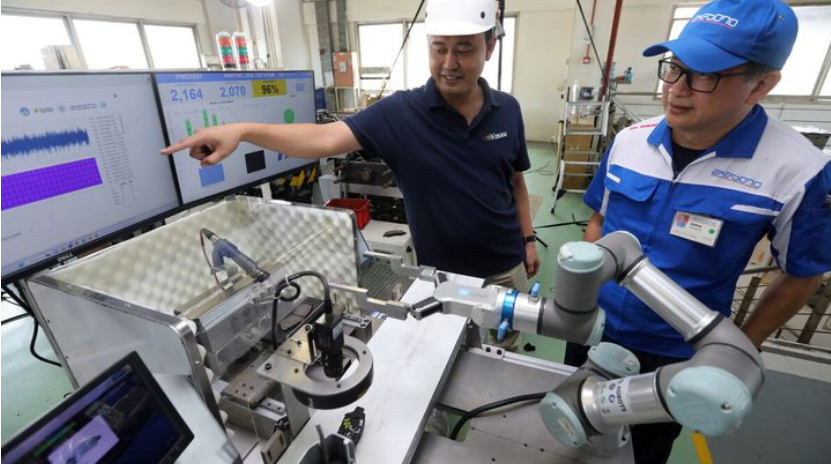
Up to now, the brake pad crack testing tool is still being perfected. In early February 2023, Aguswin demonstrated his tool at the PT. AAIJ factory located in Kelapa Gading, North Jakarta. The Director and technicians of PT AAIJ were also present during the explanation and testing process.
Aguswin expressed his gratitude for the LPDP funding through the applied scientific research program. "We are thankful because the goal here is not just about papers but about how we can provide product solutions to the industry," said the man who earned his doctorate at The University of Tokyo.