Agriculture remains a sector engaged by tens of millions of Indonesians. The Central Statistics Agency (BPS) records that in 2022, about 40.64 million Indonesians were employed in the agricultural sector, roughly 29.96 percent of the country's total population. This indicates that agriculture remains a significant source of employment for millions of Indonesians.
However, the current state of national agriculture cannot be described as advanced. Issues such as the lack of young farmer regeneration, social perspectives, the escalating demand for food due to population growth, and land use change continue to pose common challenges. Achieving food self-sufficiency remains an ongoing discourse.
Professor Dr. Irham, M.Sc, a Professor at Gadjah Mada University's Faculty of Agriculture, felt compelled to undertake reforms in Indonesia's agriculture to establish a sustainable farming model. Organic farming was proposed as a solution to enhance land and environmental quality, elevate farmers' well-being through healthy produce without the use of chemical pesticides.
Yet, until now, there has been no designated zone or specific area for organic farming supported by government regulations. Additionally, there hasn't been a governance model available for the development of organic farming areas.
Professor Irham and his team embarked on research titled "Modeling Sustainable Agriculture Governance to Support Healthy Food Availability and Farmer Welfare through the Development of Region-based Organic Farming" in collaboration with the Department of Agriculture, Food, and Fisheries of Sleman Regency as their research partner.
The output of this research is an academic manuscript submitted as the Sleman Regent's Draft Regulation to regulate and design region-based organic farming, now officially established as Regent Regulation (Perbup) Sleman No. 62 of 2023 on the Development of Region-based Organic Farming.
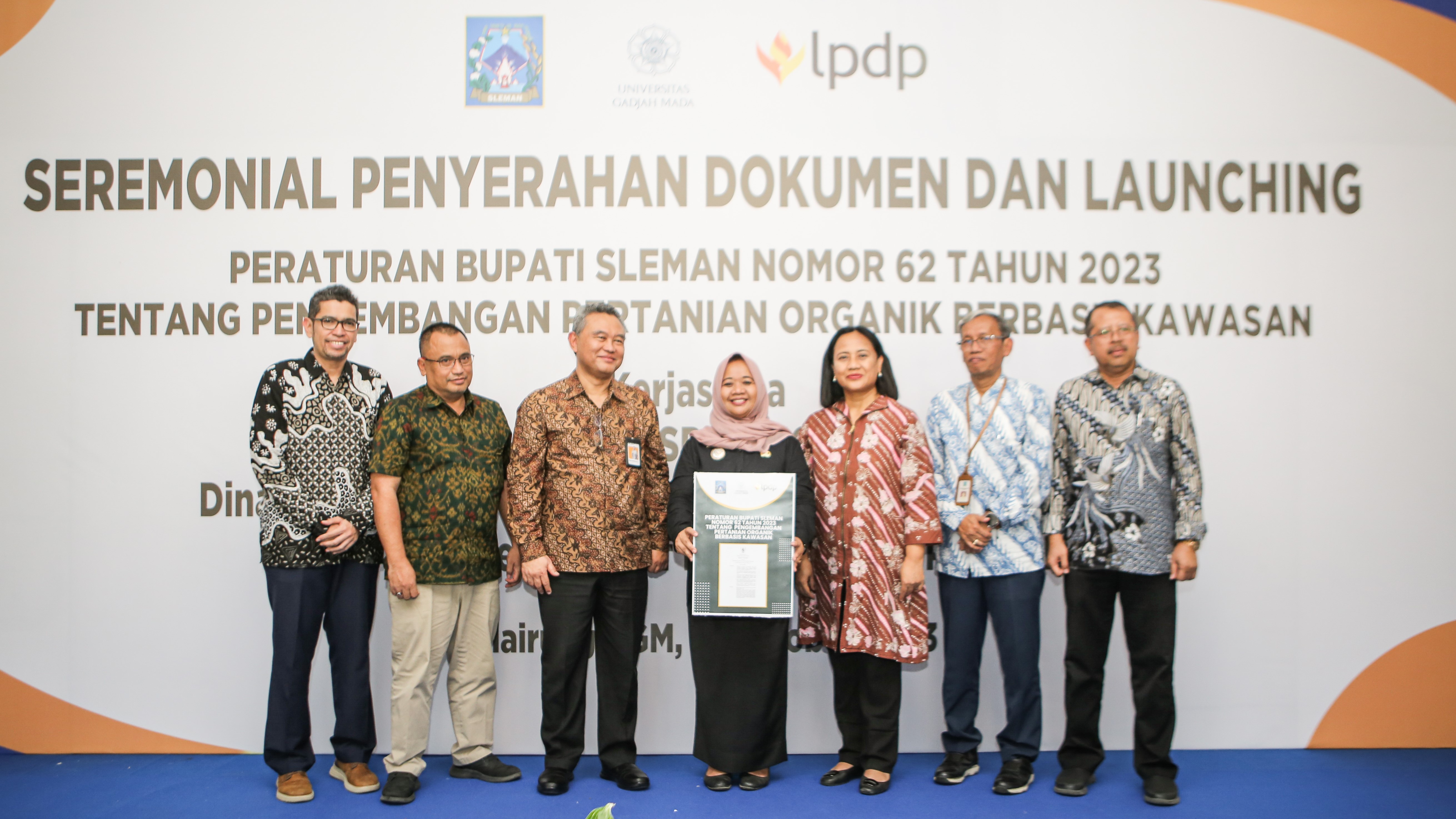
This regulation will accommodate organic farming areas as part of Sleman Regency's spatial planning. It is also integrated with an internet-based farming record system introduced by Professor Irham and his team.
"The region-based Perbup is only available in Sleman, unlike other Perbup focusing on organic farming. It's the only one in Sleman," stated Prof. Irham during an interview.
Regent Kustini of Sleman appreciated and strongly supported the academic research underlying the birth of this latest Perbup. According to her, Sleman possesses fertile agricultural potential and needs to be supported by a good sustainable farming model.
In the future, it is conceivable that this region-based organic farming Perbup will become a model and be adopted by other regions in Indonesia.
Towards Achieving a Sustainable Agricultural Model
Since 2011, Prof. Irham and researchers have conducted various studies related to the sustainability of food crop agriculture. Sustainable agriculture conditions in Indonesia are still far from ideal and have yet to become a shared initiative. This is because Indonesian agricultural models still follow the green revolution from the early era, over three decades ago.
Remnants of this green revolution can still be easily found today, characterized by the reliance on hybrid seeds and chemical pesticides in their farming practices.
According to Prof. Irham, the impact of conventional agriculture is marked by soil degradation and declining fertility. Other long-term effects also include jeopardizing farmers' health due to the use of pesticides, including in their produce. This threat endangers sustainable farming practices and leaves them lagging behind.
Implementing a sustainable farming model could potentially raise interest among younger generations to engage in farming. Coupled with the transition to modern farming equipment to enhance competitiveness and improve production and harvest quality.
Originating from Farming Record Systems
This research has undergone an extensive journey. Around 2013, Prof. Irham noticed the absence of farming records among the farmers themselves. However, recording farming activities is crucial for modern farmers' competency.
"So, when asked, they didn't have any records. If they don't keep farming records, how can they monitor their farming progress from one season to another?" he recounted.
What Prof. Irham did next was to conduct outreach to farmers, collaborating with Food Security and Agricultural Extension of Kulonprogo Regency. Gradually, Prof. Irham and his team developed a farming record platform on computers. Initially web-based, it eventually evolved to be accessible via smartphones for farmers through an application called Rektanigama (Gadjah Mada Farming Record).
The coverage of the farming record research and application varied from different locations, spanning Kulonprogo, Sleman, and Magelang. At that time, the focus was on organic farming. The reason being that organic farming was not prevalent, making it easier to organize the farming record application.
New issues arose in the field regarding the expensive cost of organic farming certification, as it was based on commodities with high quantities.
"For instance, organic rice from half a hectare incurs the same cost as that from 10 or even 100 hectares. Hence, the idea of region-based organic farming emerged," he explained the inception of the research that became the foundation for Regulation No. 62 of 2023.
Prof. Irham admitted it's not easy to change farmers' culture or habits to switch to a modern sustainable farming model. For him, these are challenges that a researcher must face and never give up on.
"We've made various efforts because there are challenges with farmers. For instance, after they switch to organic, if the price of their rice is the same as non-organic, then what's the use, right? That's why we're trying to find solutions, including educating consumers about the importance of healthy rice," he expressed.
Now, Sleman Regent Regulation No. 62 of 2023 on the Development of Region-based Organic Farming has been officially launched. The benefits of #OurMoney managed by the Ministry of Finance through LPDP have been felt by the community, particularly in the agricultural sector, contributing to the nation's progress.